×
- Hello
- Login or Register
- Quick Links
- Live Chat
- Track Order
- Parts Availability
- RMA
- Help Center
- Contact Us
- Shop for
- BMW Parts
- BMW Accessories

My Garage
My Account
Cart
Genuine BMW 2002 Piston
Engine Pistons- Select Vehicle by Model
- Select Vehicle by VIN
Select Vehicle by Model
orSeries
Model
Year
Select Vehicle by VIN
For the most accurate results, select vehicle by your VIN (Vehicle Identification Number).
3 Pistons found
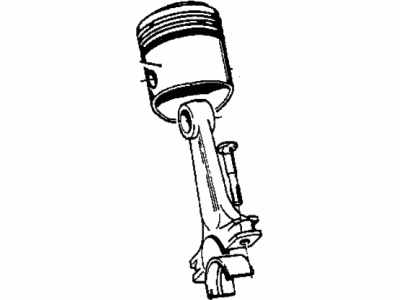
BMW 2002 Mahle Piston
Part Number: 11251261926$330.91 MSRP: $388.10You Save: $57.19 (15%)Ships in 1-3 Business Days
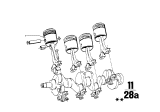
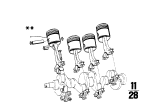
BMW 2002 Piston
The BMW 2002 Piston transforms every fiery fuel-air explosion into smooth crankshaft rotation, giving the car its splendid punchy acceleration. They are manufactured from lightweight aluminum alloy with tightly fitting rings. The Piston is designed to withstand searing heat and high pressure and minimize friction losses. In its 2002 lineup of engines, this trunk-type Piston takes side forces on its shoulder and positions its oil ring under the wrist pin to lubricate the mechanism. In spite of this design concept, other forms can offer design lessons to refine the edge. A slipper variant reduces skirt mass, enabling the engine to rotate faster, and a forged racing version of the same Piston is designed to withstand extreme revs without sacrificing strength. Although the crosshead and deflector style provide solutions for hefty diesels or two-stroke arrangements, they essentially serve to highlight the merit of the trunk design for a rev-happy BMW gasoline engine. Cooling cavities fed by oil keep temperatures in check, ensuring consistent sealing and power stroke efficiency. With each Piston element in the 2002's powertrain, BMW drivers enjoy lively throttle response and dependable durability from a compact component doing relentless heavy lifting.
If you are looking for OEM BMW 2002 Piston, we highly recommend to shop with us. Not only do we offer budget friendly prices, but we also provide fast delivery. In addition, we have a hassle-free return policy on all genuine BMW 2002 Piston that come backed by the manufacturer's warranty.
BMW 2002 Piston Parts Questions & Experts Answers
- Q:How to remove the cylinder head and sump, and what steps should be followed to extract the piston/connecting rod assembly on BMW 2002?Posted by Tony Q.A:Taken off the Cylinder Head and sump as described earlier in this article. Rotate the Crankshaft clockwise with the aid of a spanner to the nut of the pulley such that the big-end of the piston or the connecting rod is at the lowermost level. Connecting rods and big-end caps are identified at points opposite to each other, and all series start at the front of the engine with no. 1. Remove Bieg-end nuts, rotate the cap and pull the piston /connecting rod assembly out from above the block. If there is a sever wear ridge at the top of the cylinder bore, it is advisable to scrape it away before pulling the piston, in order to prevent damaging the Piston Rings. Before final assembly, the bearing shells must be removed from the cap and rod; to help distinguish between them, use masking or have a spirit marker define on the rear of the bearing shells The essential differentiation is critical if reproducing the original shells. The gudgeon pin can be pulled out after take out the circlips and pushing the pin with fingers only but be careful with the position of the rod oil hole to the arrow on the piston crown for reconnection. Eliminate the first set of big-end bolts and nuts and acquire a new set of them. The piston rings are rather fragile, and open too wide during removal, they may break; previous to removing the rings place two or three old feeler blades or strips of tin behind each ring at proper intervals. Rotate the rings counter clockwise to remove them from the top of the piston so that the feeler blades stop a lower ring from falling lower as it is pulled out.Answered by BMW Parts Specialist Armando / Dec 19, 2024