×
- Hello
- Login or Register
- Quick Links
- Live Chat
- Track Order
- Parts Availability
- RMA
- Help Center
- Contact Us
- Shop for
- BMW Parts
- BMW Accessories

My Garage
My Account
Cart
Genuine BMW 2002 Crankshaft
Crank Shaft- Select Vehicle by Model
- Select Vehicle by VIN
Select Vehicle by Model
orSeries
Model
Year
Select Vehicle by VIN
For the most accurate results, select vehicle by your VIN (Vehicle Identification Number).
1 Crankshaft found
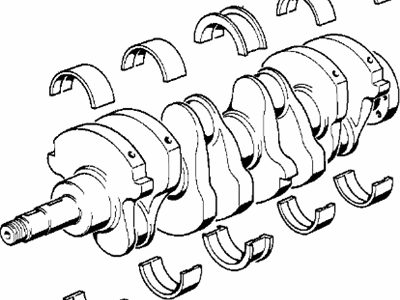
BMW 2002 Crankshaft
BMW 2002 Crankshaft converts the straight up and down thrusts of the pistons into smooth spinning power that ultimately turns the wheels, doing so by linking connecting rods to offset crank throws that change reciprocating motion into rotation within the engine block. Every BMW engine in the 2002 lineup relies on this Crankshaft to synchronize cylinders and transmission input. Cast iron versions served lower output engines, while forged steel units appeared when the motor grew hungrier for horsepower, the forged style standing up to higher stresses thanks to denser metal. Both styles sit deep in the block on precision journals, bathed in oil that prevents metal to metal contact, meaning regular oil changes are vital for a long service life. Dirt or reduced lubrication can score journals, widen clearances and cause engine knock, and if debris hampers movement the Crankshaft may vibrate or even break. Should replacement become necessary, the heavy yet delicate Crankshaft demands careful removal of bearing caps, alignment of new bearings and accurate torque on reinstall to keep rotation free of binding, tasks that make swapping this Crankshaft a difficult multihour job for any 2002 enthusiast who tackles their own BMW maintenance.
If you are looking for OEM BMW 2002 Crankshaft, we highly recommend to shop with us. Not only do we offer budget friendly prices, but we also provide fast delivery. In addition, we have a hassle-free return policy on all genuine BMW 2002 Crankshaft that come backed by the manufacturer's warranty.
BMW 2002 Crankshaft Parts Questions & Experts Answers
- Q:How to inspect, measure, regrind, and reinstall the crankshaft and bearings on BMW 2002?Posted by Forrest E.A:Examine the crank pin and main journal surfaces for signs of scoring or scratches, and check the ovality of the crank pins at different positions with a micrometer; if they are out of round beyond specified limits, regrinding is necessary, as well as for any scores or scratches present. If regrinding the crankshaft and fitting new bearings is required, a local BMW garage or engineering works can determine how much metal to grind off and the size of new bearing shells, along with the restoration of surface hardening (Nitriding) of the bearing surfaces. Main bearing clearances can be established using a strip of 'Plastigage' between the crankshaft journals and the main bearing/shell caps, tightening the bearing cap bolts to a torque of 45 lb/ft (62 Nm) before removing the cap to compare the flattened Plastigage strip with the provided index. Temporarily refit the crankshaft to the crankcase with the upper halves of the shell main bearings in place, fitting only the no.3 main bearing cap with the shell bearing and tightening the securing bolts to 45 lb/ft (62 Nm) torque; check the end float with a feeler gauge, and if it is outside the specified tolerance, renew the no. 3 bearing shells. Finally, check the pilot ball race in the center of the crankshaft rear flange for wear or damage, and if necessary, extract it. When installing new pilot bearing components, pack the bearing with high-melting point grease and impregnate the felt ring with hot tallow, ensuring the marking on the cover plate faces outwards before tapping the retainer into place until it seats.Answered by BMW Parts Specialist Blaine / Jul 22, 2025