×
- Hello
- Login or Register
- Quick Links
- Live Chat
- Track Order
- Parts Availability
- RMA
- Help Center
- Contact Us
- Shop for
- BMW Parts
- BMW Accessories

My Garage
My Account
Cart
Genuine BMW 2002 Thermostat
Engine Coolant Thermostat- Select Vehicle by Model
- Select Vehicle by VIN
Select Vehicle by Model
orSeries
Model
Year
Select Vehicle by VIN
For the most accurate results, select vehicle by your VIN (Vehicle Identification Number).
1 Thermostat found
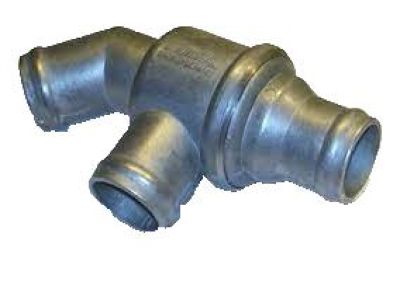
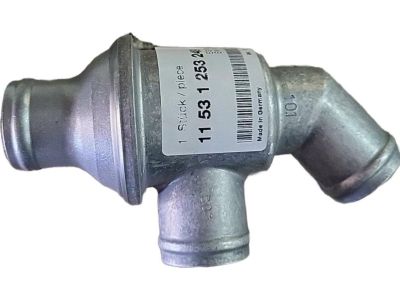
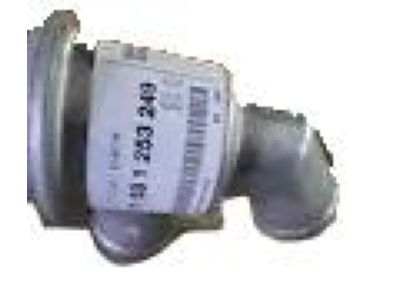
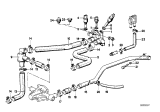
BMW 2002 Thermostat
Part Number: 11531253249$267.39 MSRP: $336.66You Save: $69.27 (21%)Ships in 1-3 Business Days
BMW 2002 Thermostat
The BMW 2002 Thermostat protects the classic sport sedan by maintaining a safe level of engine heat. This can damage the engine on its own if coolant flow is stalled, causing damaging spikes in engine heat. Seated between the inner and outer coolant circuits is this little closed loop control device. As water temperature rises, when the liquid is hot enough, the Thermostat springs open, allowing the cooler outer flow to flood down the block and radiator, which rapidly draws off excess heat. Early 2002 models relied on a simple mechanical bellows design, while later versions adopted a robust wax pellet unit that expands upon being heated and forces the valve open with greater accuracy. Both of these styles act on the same principle, but the wax pellet is more sensitive to slight changes in temperature and thus helps the car to warm up more quickly on cold mornings without causing boil-overs in spirited driving. This consistency provides a sense of confidence for BMW enthusiasts on long travel. Unlike household HVAC regulators or the pneumatic room controls invented in the nineteenth century, an automotive Thermostat measures coolant directly, not toggling some sort of heater switch. As such, if a stuck Thermostat is present, some form of immediate overheating will occur. Many 2002 owners who monitor temperature gauges and replace the Thermostat at service intervals keep their BMW running cool for decades.
If you are looking for OEM BMW 2002 Thermostat, we highly recommend to shop with us. Not only do we offer budget friendly prices, but we also provide fast delivery. In addition, we have a hassle-free return policy on all genuine BMW 2002 Thermostat that come backed by the manufacturer's warranty.
BMW 2002 Thermostat Parts Questions & Experts Answers
- Q:How can a faulty thermostat affect engine performance and what steps should be taken to test and replace it on BMW 2002?Posted by Sylvain G.A:A faulty thermostat can lead to overheating or slow engine warm-up and negatively impact heater performance. Begin by draining enough coolant through the Radiator drain tap until the coolant level is below the thermostat housing, indicated by the exposure of cooling tubes when viewed through the radiator filler cap. Next, disconnect the three hoses from the thermostat and remove it for later models or unbolt the thermostat housing cover for early 1500 models. For early 1500 models, withdraw the thermostat cover enough to allow the thermostat to be removed from its seat in the cylinder head. To test the unit's serviceability, suspend the thermostat by a piece of string in a pan of heated water. Using a thermometer, check its operation against the specified opening and closing temperatures. The thermostat should be replaced if it is stuck open or closed or fails to operate at the specified temperature of 176 degrees Fahrenheit (80 degrees Celsius). For later models, measure the thermostat's opening by inserting a steel rule when cold and again after heating; the difference should be between 0.315 and 0.354 in (8.0 and 9.0 mm) from the end of the thermostat hose connecting nozzle. Allow time for the thermostat to operate, and never refit a faulty unit.Answered by BMW Parts Specialist Blaine / Apr 17, 2025